The Industry Landscape
Finance Transformation in Decentralized Enterprises
Large organizations with distributed networks face a common finance challenge: Legacy operating models that are optimized for local autonomy. These typically feature embedded finance teams, localized reporting practices and significant discretion over their budgeting and spend. While this model supports responsiveness at the entity level, it creates fragmentation across the organization’s processes, controls and data.
As enterprises grow, this fragmentation limits business visibility, weakens governance and constrains finance’s ability to act as a strategic partner. The imperative for finance leaders is universal – standardize without disruption, centralize without losing business context and re-deploy skilled talent toward insight-led decision-making.
The Client Challenge
Decentralized Control, Limited Insights
A global education leader operated each school in its extensive network as a separate legal and operational entity, with finance teams reporting primarily to school principals or CEOs. Corporate finance involvement was largely limited to consolidation, resulting in a highly decentralized finance landscape.
This operating model created multiple, compounding challenges:
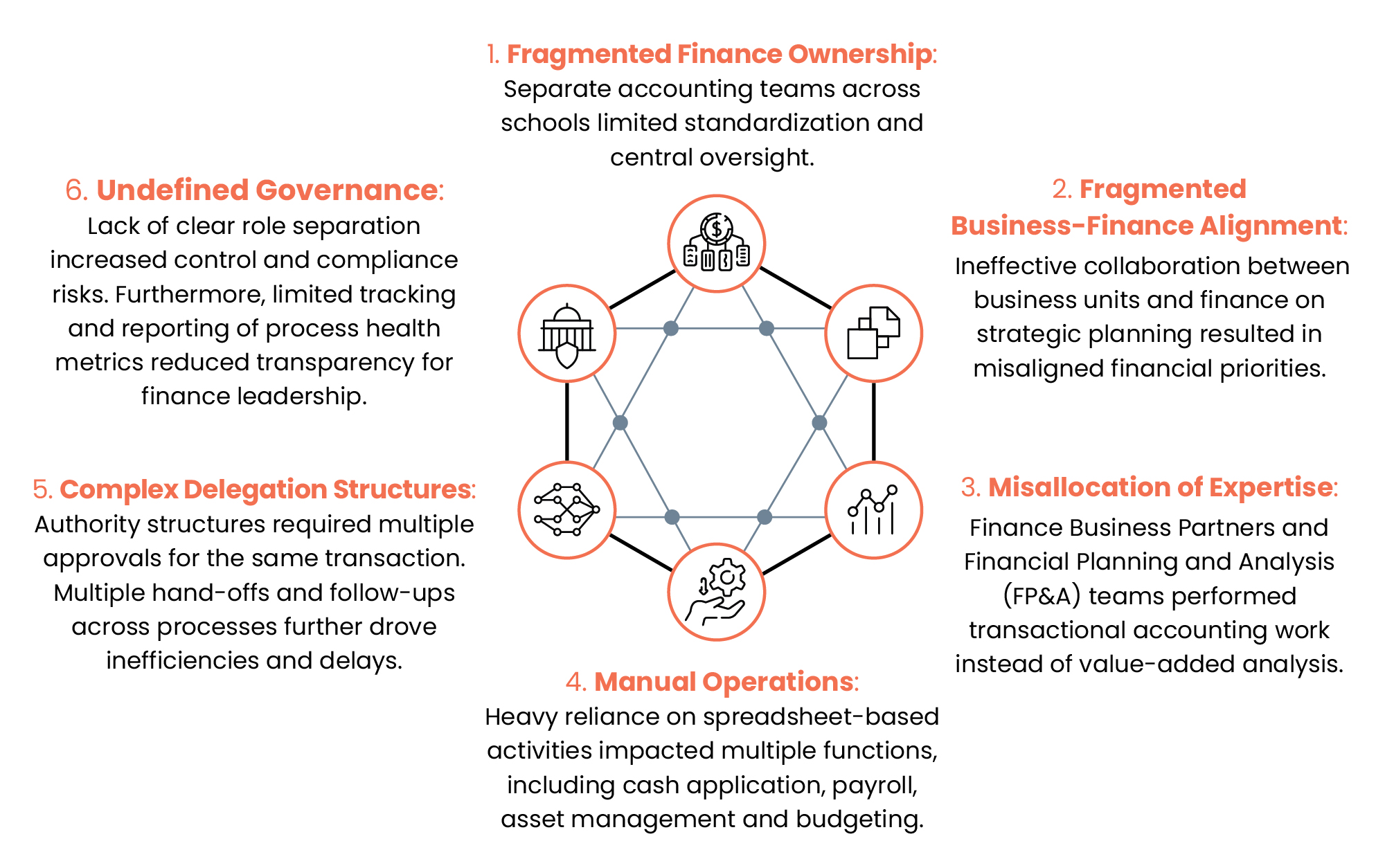
Together, these issues constrained productivity, diluted financial insight and limited leadership’s ability to monitor process health or drive sustainable improvement.
The Solution
A Future-ready Finance Operating Model using 
WNS partnered with the client in a consultative engagement to design a scalable target operating model. The engagement was anchored in WNS’ proprietary, Artificial Intelligence (AI)-led Agile Target Operating Model (aTOM) platform, enabling structured diagnosis and a clear path from assessment to value-realization.
The New Operating Model, Re-imagined Around Scale and Control
WNS designed a horizontal finance structure anchored in a Finance Shared Services Center (FSSC) that consolidated core accounting and transaction-intensive activities while defining clear governance interfaces with schools and corporate stakeholders. Key elements of this transformation included:

Process-led Organization Design
Finance was re-organized around end-to-end processes rather than individual entities. Key interventions included:
- Defining Full-Time Equivalent (FTE) splits and clarifying roles across Procure-to-Pay (P2P), Order-to-Cash (O2C), Record-to-Report (R2R) and FP&A
- Re-designing job descriptions for FSSC accounting roles
- Re-positioning Finance Business Partners as Financial Analysts, focused on insight and decision support
- Embedding segregation of duties to strengthen governance and compliance

Standardized and Streamlined Processes
Core accounting workflows were re-designed to eliminate duplication and non value-adding activities. Focus areas included:
- End-to-end re-designing of P2P, O2C and R2R processes
- Clearly defining process controls and governance mechanisms
- Standardizing ways of working aligned to business outcomes
- Creating comprehensive ‘to-be’ process maps for all in-scope activities

Technology-enablement and Automation
Preference was given to optimizing the existing technology landscape rather than introducing unnecessary complexity. Recommendations included:
- Right-fit automation opportunities supported by WNS' bolt-on tools
- A case-management capability to manage parent and internal queries with standardized reason codes and tracking
- Deployment of WNS TRAC eClose, tailored for distributed teams to provide visibility and control over month-end close activities
Transformation Roadmap and Change Management
To reflect portfolio diversity, schools were segmented into Premium, Mid-Market Plus and Mid-Market clusters, enabling differentiated service design without compromising standardization or control.
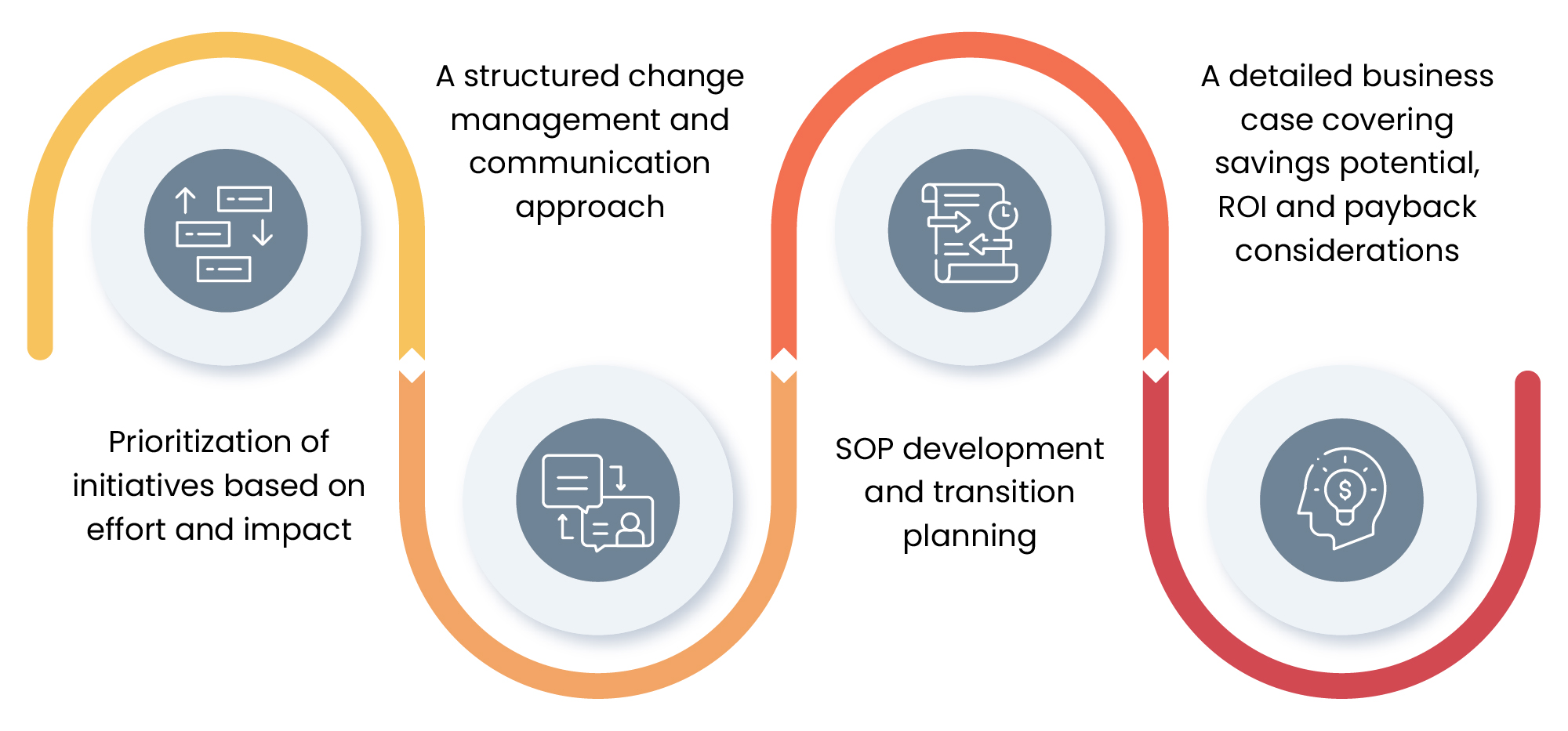
WNS developed a phased transformation roadmap spanning immediate, mid-term and long-term horizons (6 months, 12-24 months and 24+ months). This was supported by:
The Outcome
Actionable Insights with Tangible Benefits
The engagement delivered a clear, future-ready blueprint for finance transformation, enabling the organization’s leadership to take informed decisions on centralization with minimal disruption to ongoing operations. Enterprise-level benefits included:

A centralized, governed finance organization with clear accountability

Improved utilization of finance talent toward analysis, insight and decision support

Enhanced visibility into process performance through defined health metrics

A phased transition approach covering 44 schools across Premium, Mid-Market Plus and Mid-Market segments
Quantified Business Impact
~ percent
productivity improvement driven by consolidation, continuous improvement and automation over 3 years
~ percent
upfront reduction in shared services headcount, through elimination of redundant activities and process improvements
~USD Million
in projected overall savings
Client Testimonial
I would like to first thank you for your work during the assessment and diagnostic phase. Your practical advice and deep understanding of the processes, as well as the clear identification of areas for improvement, were particularly valuable. The insights provided were relevant and actionable. Overall, our cooperation during phase one was fruitful and I am confident that we will continue working positively on the transformation of the finance function to achieve the expected efficiencies.
- Vice President, Financial Reporting