1

Autonomous Systems Are Set to Revolutionize the Insurance Industry
What’s Driving this Trend
Over the past few years, insurers have experimented extensively with AI across functions such as claims triage, customer service, document ingestion and subrogation. While these initiatives have delivered localized efficiency gains, most deployments remain siloed, rules-driven and incremental. The result is a fragmented AI landscape that automates tasks but stops short of re-thinking how work gets done across the value chain.
Advances in Agentic AI are changing this equation. Autonomous systems can now reason, coordinate actions across systems and learn from outcomes, enabling insurers to move from task automation to decision-centric operations. This shift is laying the foundation for AI that operates across processes, not just within them.
How Can Insurers Unlock Value
Skepticism in insurance C-suites and boardrooms centers on ROI, enterprise risk, and regulatory uncertainty. To maximize value from autonomous systems, organizations must reimagine workflows end-to-end rather than forcibly adding agents to legacy processes. The greatest impact will come from prioritizing enterprise productivity, using AI agents for decision-making, automation for routine workflows, and assistants for information retrieval – in turn driving measurable gains in cost, quality, speed and scale.
Why it Matters
By 2026, autonomous systems will move into early mainstream adoption. Leading insurers looking to deploy at scale, will be able to elevate CX while improving productivity and operating leverage. Routine servicing will be fully automated, delivering faster resolutions and consistent outcomes, while AI-led operations will handle high-volume decision-making with greater accuracy.
Equally important, this model preserves and elevates the human role. Complex claims, disputes and emotionally sensitive interactions are escalated to skilled professionals, supported by AI-generated context and insights. The result is a more responsive, empathetic customer journey, reduced cycle times, lower operating costs and stronger trust at moments that matter most.
Take claims processing, for instance. AI agents can orchestrate the end-to-end journey from intake to settlement – verifying coverage, assessing fraud risk, requesting additional information and triggering payments within defined guardrails and human oversight. In practice, we have seen this reduce settlement time by 30 percent, cut cost-per-claim by 25 percent and improve financial accuracy by 90 percent. Furthermore, over 40 percent of claims are processed straight through with minimal intervention, while complex cases are routed with full context – reducing re-work, leakage and customer dissatisfaction.
How Can Insurers Unlock Value
Skepticism in insurance C-suites and boardrooms centers on ROI, enterprise risk, and regulatory uncertainty. To maximize value from autonomous systems, organizations must reimagine workflows end-to-end rather than forcibly adding agents to legacy processes. The greatest impact will come from prioritizing enterprise productivity, using AI agents for decision-making, automation for routine workflows, and assistants for information retrieval – in turn driving measurable gains in cost, quality, speed and scale.
2

Enterprise AI Orchestration Is Becoming a Competitive Imperative
What’s Driving this Trend
Today, most AI initiatives are task-based: a claims agent that classifies documents, a data-ingestion agent that structures evidence or a pricing agent that supports underwriters. While effective in isolation, these point solutions rarely connect across functions and leadership is zeroing in on fragmentation that is capping AI’s enterprise impact.
How Can Insurers Unlock Value
Maximizing the impact of multi-agentic AI requires re-wiring operating models, workflows and data and technology foundations, embedding scalable, re-usable AI capabilities across functions. Adopting a domain-based approach and comprehensively re-engineering functions is already delivering measurable impact, including:4
Why it Matters
Multi-agentic AI workflows3 are poised to transform the situation in 2026. In this model, agents will continuously exchange information: claims data flowing back into pricing; pricing movements informing underwriting appetite; underwriting trends updating risk-selection policies.
One leading insurer introduced an award-winning multi-agent AI research assistant to help underwriters handle large volumes of unstructured data, informing faster and more consistent underwriting decisions, with people stepping in only where needed. Key benefits from this included 92 percent reduction in research costs and 85 percent reduction in report-generation time.
How Can Insurers Unlock Value
Maximizing the impact of multi-agentic AI requires re-wiring operating models, workflows and data and technology foundations, embedding scalable, re-usable AI capabilities across functions. Adopting a domain-based approach and comprehensively re-engineering functions is already delivering measurable impact, including:4

0–0%
gains in sales conversion

0–0%
premium growth

0–0%
improvement in claims accuracy
3

Dynamic Pricing Will Remain Key to Competitive Advantage
What’s Driving this Trend
In a world defined by climate volatility, geopolitical shocks and economic disruption, traditional insurance pricing, built on historical data refreshed quarterly or annually, is increasingly inadequate.
How Can Insurers Unlock Value
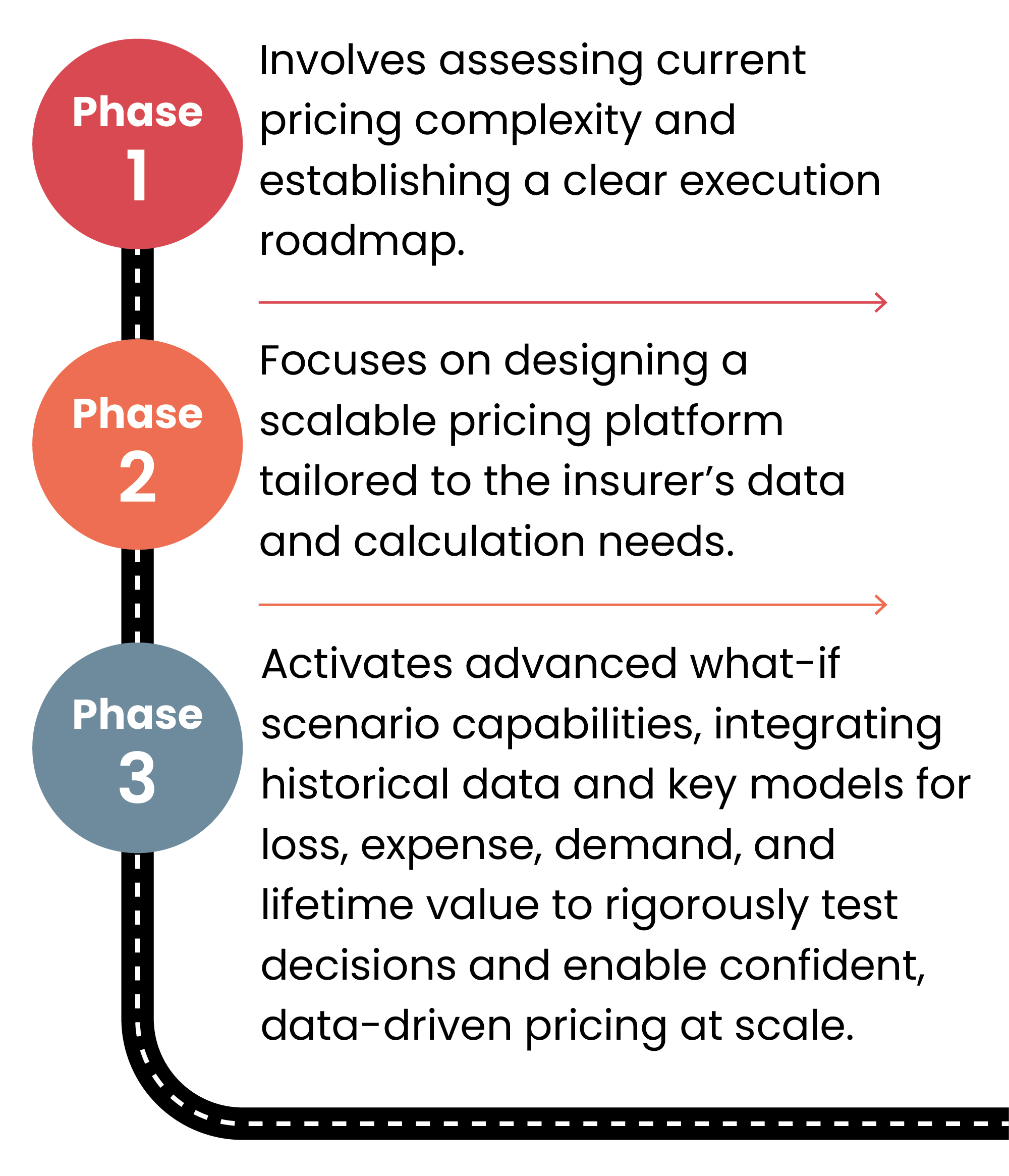
Maximizing value from dynamic pricing requires a phased approach.
Capgemini research indicates that dynamic pricing platforms can improve speed to market by 70-90 percent and combined ratios of Lines of Business (LoB) by 1.5-3 percent.5
Why it Matters
Dynamic pricing enables carriers to continuously respond to emerging risks and changing market conditions by rapidly adjusting pricing structures to improve their competitive position without sacrificing profitability. Starting 2026, leading insurers will embed real-time external data – such as weather forecasts and satellite imagery, inflation and commodity price movements, and logistics alerts – directly into AI-driven pricing engines. These systems will continuously translate external signals into dynamic premium adjustments and exposure re-balancing, while claims agents proactively prepare for surge events.
How Can Insurers Unlock Value
Maximizing value from dynamic pricing requires a phased approach.
Capgemini research indicates that dynamic pricing platforms can improve speed to market by 70-90 percent and combined ratios of Lines of Business (LoB) by 1.5-3 percent.5
4

Experience-led Journeys Will Re-define CX Standards
What’s Driving this Trend
Historically, insurance engagement has revolved around purchase, policy changes, renewal and claims. Today’s policyholders expect pricing guided by real-time behavior and risk signals, underwriting powered by rich data, communication through their preferred channels, and the flexibility to adjust coverage on demand.
How Can Insurers Unlock Value
The pivot to experience-led journeys moves insurance from claims settlement to loss prevention, risk reduction and continuous engagement. Delivering these journeys requires a business-led roadmap, the right data foundation and scaled AI adoption – such as Generative AI (Gen AI) that delivers deep customer insights to personalize products and pricing, and compress product development cycles from months to weeks through continuous learning.
Why it Matters
Despite extensive data and CX investment, insurers struggle to deliver seamless experiences because product-centric, siloed operating models lack the deep customer insights needed for personalized journeys. While the effort to design such journeys may seem daunting, the payoff can be substantial: increased profitable growth, lower loss ratios, new revenue streams and the transition from commoditized products toward differentiated, customer-focused solutions.6
How Can Insurers Unlock Value
The pivot to experience-led journeys moves insurance from claims settlement to loss prevention, risk reduction and continuous engagement. Delivering these journeys requires a business-led roadmap, the right data foundation and scaled AI adoption – such as Generative AI (Gen AI) that delivers deep customer insights to personalize products and pricing, and compress product development cycles from months to weeks through continuous learning.
5

Trust Is Emerging as the Core Currency and Differentiator of AI-enabled CX
What’s Driving this Trend
The very technologies driving innovation in insurance – cloud platforms, API ecosystems, IoT and AI – are also increasing exposure to cyber risk. As AI adoption accelerates across underwriting, claims, service and customer engagement, customers and regulators are raising concerns around privacy and fairness.
How Can Insurers Unlock Value
Driving lasting impact and trust requires insurers to move beyond a strong security foundation by evolving culture, strengthening human capabilities and actively managing partnerships. Success will depend on creating a synergistic digital-human ecosystem, where Agentic AI handles end-to-end decision loops while humans provide governance, ethical oversight and empathetic engagement.
In claims, digital-first insurers can expect AI to automate self-service, improving efficiency by 60 percent and reducing cycle times by 40 percent. Meanwhile, transparent, accountable practices – human oversight, clear disclosure and customer appeal mechanisms – reinforce trust through clarity, fairness and control.
Why it Matters
As breaches and ransomware incidents continue to erode confidence, insurers must treat data protection as a strategic priority by strengthening cyber defenses, rigorously managing third-party risk and embedding security into everyday operations to preserve trust and reputation.

How Can Insurers Unlock Value
Driving lasting impact and trust requires insurers to move beyond a strong security foundation by evolving culture, strengthening human capabilities and actively managing partnerships. Success will depend on creating a synergistic digital-human ecosystem, where Agentic AI handles end-to-end decision loops while humans provide governance, ethical oversight and empathetic engagement.
In claims, digital-first insurers can expect AI to automate self-service, improving efficiency by 60 percent and reducing cycle times by 40 percent. Meanwhile, transparent, accountable practices – human oversight, clear disclosure and customer appeal mechanisms – reinforce trust through clarity, fairness and control.
Leading the Future of Insurance
Customer expectations are soaring alongside rapidly advancing AI technologies. P&C customers demand speed and convenience while L&A customers prioritize trust, transparency and long-term guidance. Meeting these expectations demands a fundamental shift in operations: from sequential processes to continuous optimization, from static portfolios to self-adjusting books of business and from reactive risk management to anticipatory risk steering.
The question for insurance leaders is how quickly and decisively they are prepared to act to maintain market leadership. As technology choices grow more complex, success will depend on strategic collaboration with domain-led, AI-powered partners to build an adaptable technology architecture that evolves with changing business strategies. In the new reality, competitive advantage will come not merely from adopting AI, but from embedding it across enterprise-wide workflows while relentlessly prioritizing customer needs.
Talk to our experts to discover how enterprise-wide AI orchestration can deliver value at every step of the customer journey and drive growth.
References
-
2026 global insurance outlook | Deloitte Insights
-
Elevating customer experience: A win–win for insurers and customers | McKinsey
-
Customized multi-agentic AI workflows made simple
-
The future of AI for the insurance industry | McKinsey
-
Insurance-Dynamic-Pricing.pdf
-
Insurance 2030: From customer worst to customer first