The Industry Landscape
Re-inventing Conveyancing Operations in Legal Services
Conveyancing is one of the most volume-intensive and risk-sensitive processes within legal services. Rising transaction volumes, tight completion timelines and increasing regulatory scrutiny place sustained pressure on law firms to deliver speed and accuracy at scale. Many firms continue to rely on manual reviews, fragmented workflows and limited performance visibility, creating bottlenecks and inconsistent client outcomes.
As demand fluctuates with market conditions and regulatory changes, leading firms are re-thinking their operating models. The focus is shifting toward digitally enabled delivery, standardized governance and analytics-driven capacity planning to ensure resilience, transparency and cost-efficiency without diluting service quality.
The Client Challenge
Scaling Without Visibility
The client faced growing complexity and volume in its conveyancing operations and needed a partner that could deliver both agility and scale.
Limited visibility into turnaround times, Full-time Equivalent (FTE) utilization and quality metrics was driving inefficiencies, slower processing and inconsistent customer experience. The challenge was compounded by the need for accelerated go-live timelines and uninterrupted service continuity as market volatility tested operational resilience.
The Solution
A Phased, Governance-led and Digitally Enabled Delivery Model
WNS collaborated with the firm to re-design and scale its conveyancing support processes through structured transition planning, standardized governance and digital-first operations. The model combined process re-engineering, legal-tech integration and embedded analytics to deliver speed, accuracy and transparency from day one.
The transformation was centered on:
This approach resolved immediate operational challenges while laying the foundation for scalable, analytics-led conveyancing operations with continuous governance.
The Outcome
Scalable Delivery with Sustained Quality and Client Confidence
The transformation delivered a resilient, high-performing conveyancing operation with full transparency and control. The firm gained real-time visibility into performance and capacity, enabling improved planning, stronger compliance and a consistently positive client experience.
Beyond near-term efficiency gains, the engagement positioned the firm for long-term scalability and digital maturity, allowing it to flex capacity, manage market volatility and maintain competitive differentiation without incremental overhead.
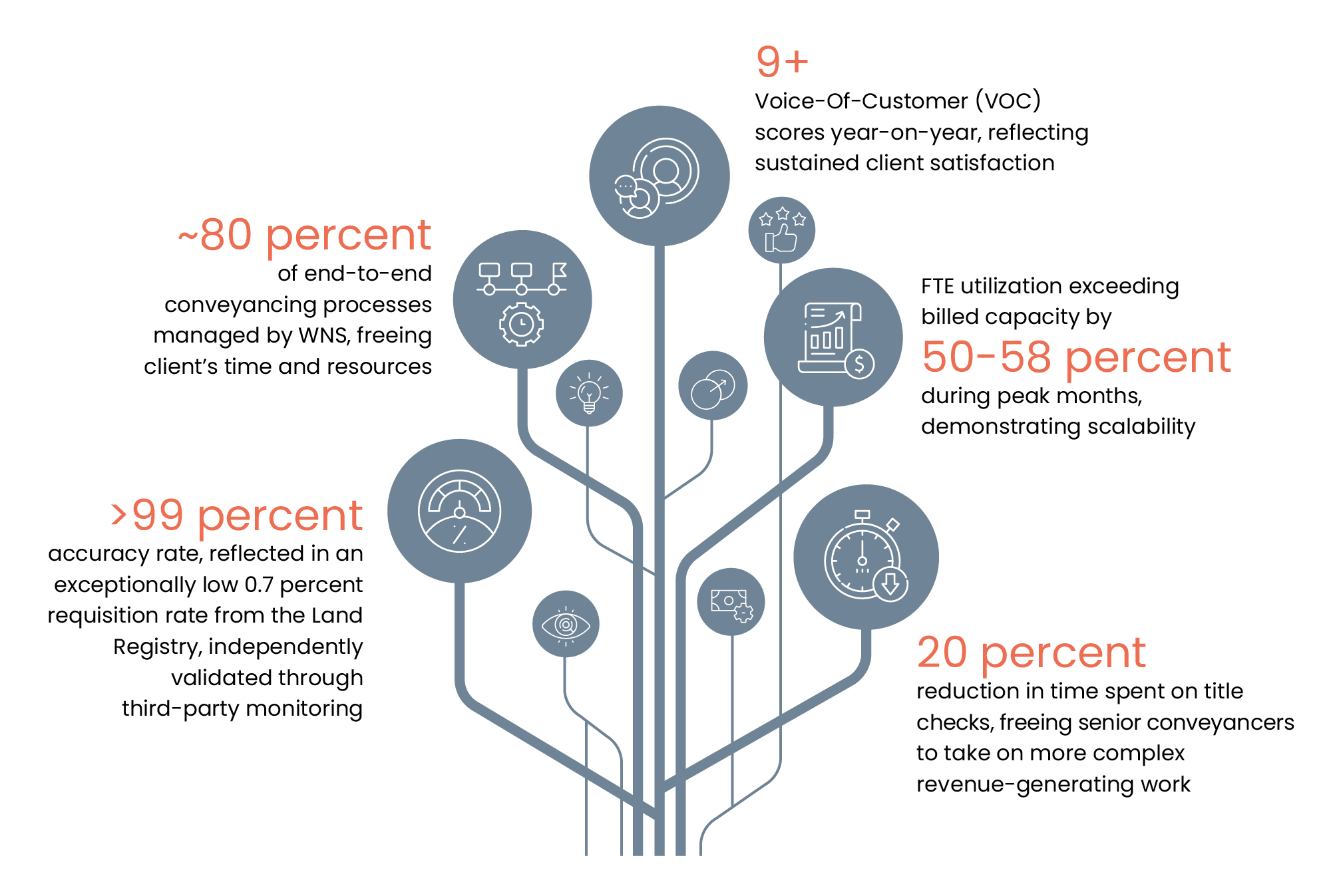
Key tangible outcomes included:
FAQs
1. How does WNS support digital conveyancing for law firms?
WNS supports digital conveyancing by building scalable, technology-enabled operating models that streamline end-to-end property transaction workflows. Through automation, process standardization, and integrated legal-tech platforms, WNS enhances speed, accuracy, and visibility, enabling law firms to manage high-volume conveyancing efficiently while ensuring compliance and consistent client experience.
2. What are the benefits of law firm digital transformation?
Law firm digital transformation improves operational efficiency, reduces manual effort, and enhances case visibility across legal workflows. It enables faster turnaround times, better compliance, and scalable operations. With automation and data-driven insights, firms can improve client experience, reduce costs, and adapt quickly to changing legal service demands.
3. How can legal operations transformation improve conveyancing efficiency?
Legal operations transformation improves conveyancing efficiency by standardizing workflows, reducing manual intervention, and introducing automation in document handling and case tracking. It enables better workload management, faster processing, and improved accuracy. This leads to predictable turnaround times and higher operational throughput in high-volume conveyancing environments.
4. Why is digital conveyancing important for modern legal services?
Digital conveyancing is important as it enables faster, more transparent, and scalable property transaction processing. It reduces reliance on manual paperwork, improves compliance, and enhances visibility across case stages. This helps law firms meet increasing demand, reduce delays, and deliver a more reliable and efficient client experience.
5. How did WNS improve scalability for a leading law firm?
WNS improved scalability by redesigning the operating model with standardized processes, automation, and real-time performance visibility. This enabled the law firm to handle fluctuating conveyancing volumes efficiently. The solution ensured consistent quality, optimized resource utilization, and supported rapid scaling without compromising turnaround time or compliance standards.
6. What role does analytics play in legal operations transformation?
Analytics plays a critical role in legal operations transformation by providing real-time insights into workloads, turnaround times, and process efficiency. It enables better decision-making, capacity planning, and performance monitoring. For conveyancing operations, analytics improves transparency, identifies bottlenecks, and drives continuous operational improvement and scalability.