Enterprise Artificial Intelligence (AI) has entered a new phase. After demonstrating value through pilots and localized use cases, organizations are now focused on embedding AI more deeply in day-to-day operations. According to a 2025 survey, 88 percent of organizations are using AI in at least one business function, reflecting one of the fastest adoption curves seen for any enterprise technology.1 As usage expands, global enterprises and digital-first leaders are increasingly operating AI at scale, ensuring models are continuously supported, data remains reliable and performance is sustained across use cases.
Early adopters are already seeing the impact of this approach. Firms that have invested in integrated workflows and operating discipline around technology report strong returns, with an average 3.7x ROI on AI-related investments across industries and regions.2 Sustaining these gains requires the right foundations – from secure data handling and governed workflows to the operating capacity needed to support model training and evolution.
Moving Beyond One-off Builds to Scalable AI Enablement
In the technology and professional services sector, running AI consistently across the enterprise introduces a different set of demands than building individual use cases. What works well in controlled environments must be supported across multiple systems, teams and geographies, often with varying data definitions and review practices. As these differences surface, maintaining consistency in data preparation, annotation and human oversight becomes central to sustaining performance and enabling reuse.
To address this, many organizations are shifting from project-centric delivery to an operating model that leverages AI-as-a-Service (AIaaS). Rather than re-building data pipelines, annotation processes and validation mechanisms for each initiative, AIaaS standardizes how AI is developed, trained and supported. This approach allows AI capabilities to scale more predictably, while giving organizations a structured way to manage cost, quality and governance as intelligent technologies become embedded across business workflows.
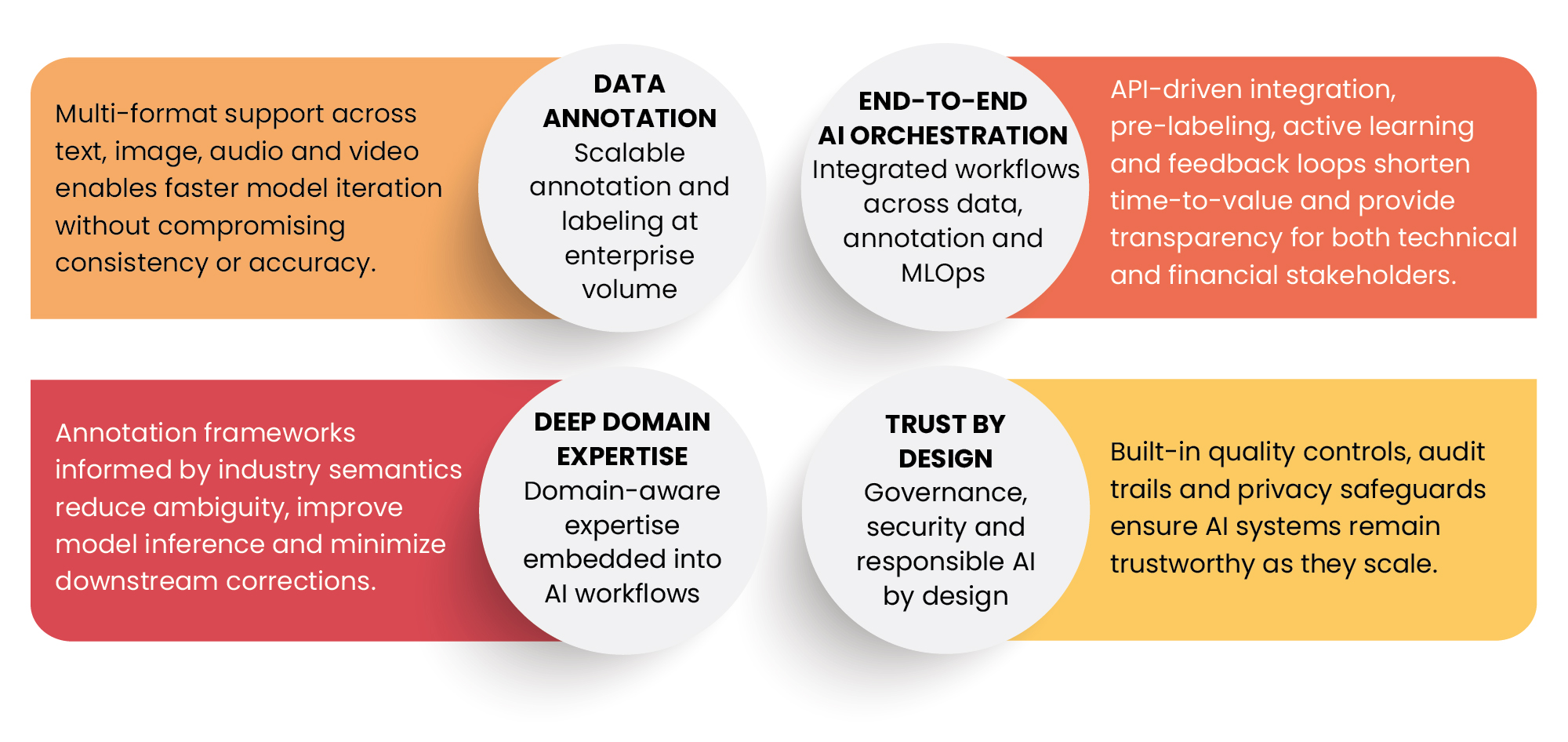
Data Annotation as the Learning Backbone of AIaaS
In an AIaaS model, data annotation becomes the mechanism that allows AI systems to remain reliable once they move beyond controlled pilots into enterprise production. As AI systems are consumed across multiple use cases and exposed to evolving data, scalable annotation ensures models can be refined, corrected and adapted without disrupting operations. This makes annotation central to how AIaaS maintains accuracy and relevance as enterprises scale.
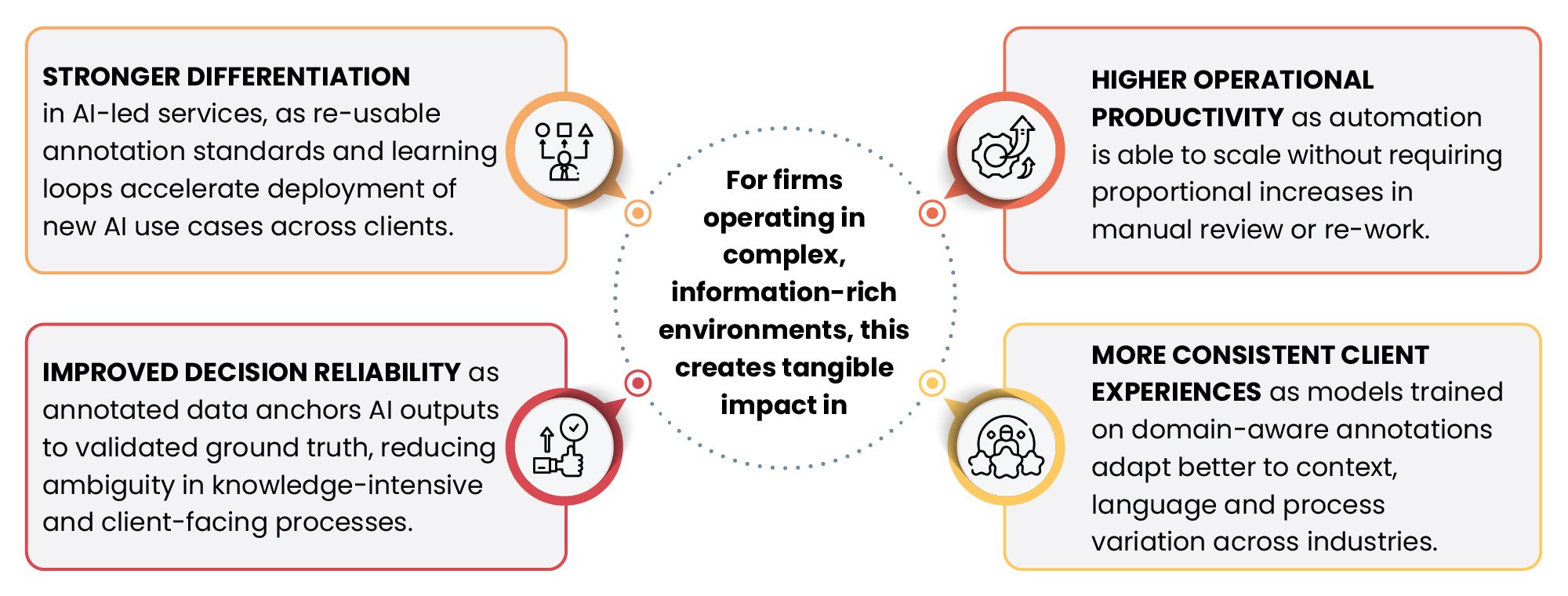
Human-in-the-Loop (HITL): A Designed Control and Improvement Layer
AI and machine learning can automate and accelerate many decision-driven processes. However, for AIaaS to operate reliably at enterprise scale, human expertise must be embedded as a structured operating layer. The governance, judgment, output validation and feedback that the HITL approach provides becomes a direct input for model improvement, enabling reinforcement learning and continuous optimization.
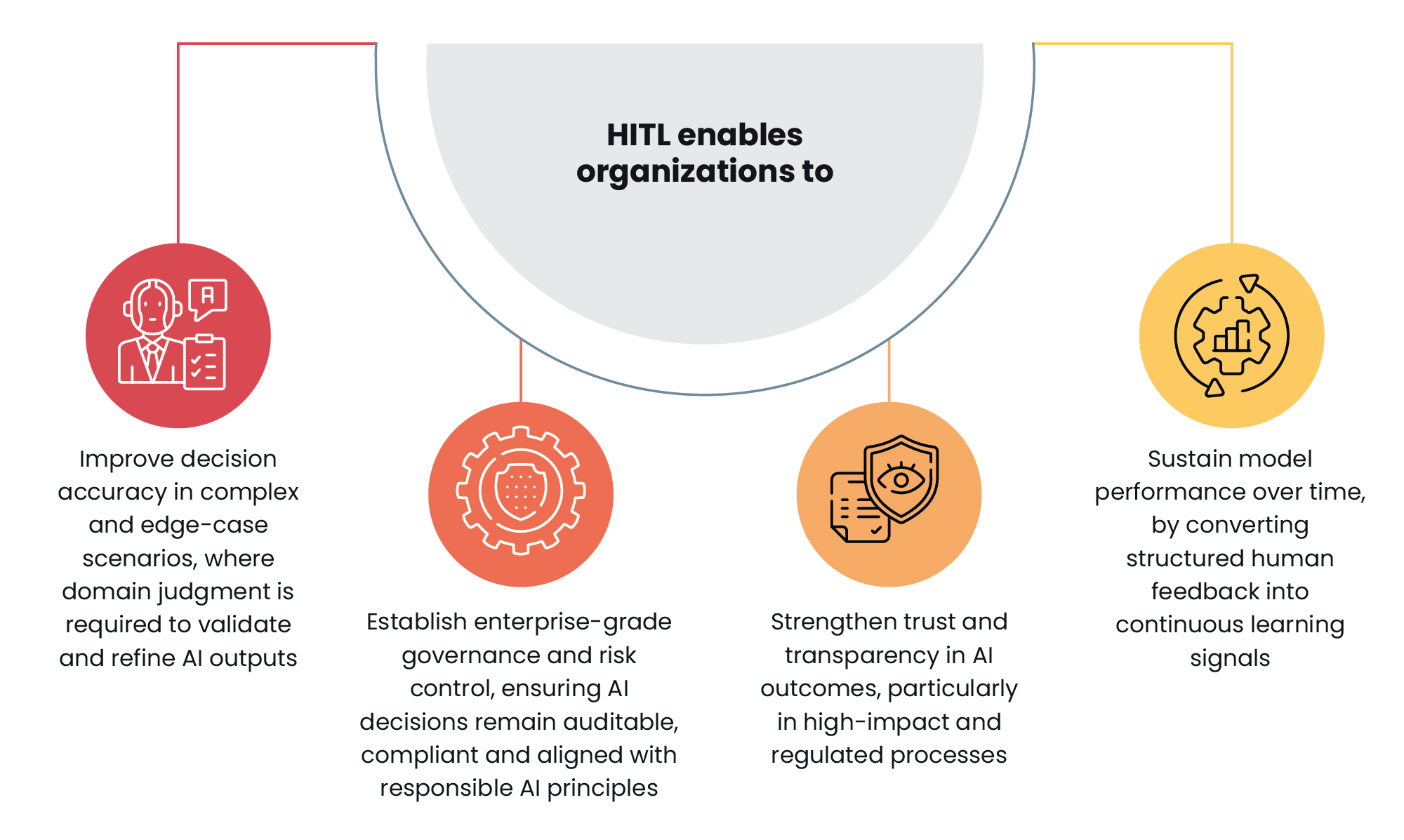
Closing the Loop Between Operations, Learning and Governance
When AIaaS, data annotation and HITL are orchestrated into a single operating system, organizations establish a closed-loop model for AI execution. Data flows into annotation, human validation informs feedback, models improve iteratively and governance is enforced through traceable workflows and quality controls. This integrated approach allows AI to move beyond experimentation and deliver sustained business value with speed, reliability and confidence.
Operationalizing this model at scale, however, requires capabilities that involves translating AIaaS from an architectural concept into a repeatable, enterprise-grade reality. In practice, many firms rely on strategic partners, who:
ENABLE OUTCOME-DRIVEN AI EXECUTION
Translate business objectives into scalable AI execution, ensuring AI investments remain focused on priority outcomes rather than fragmented experimentation
COMPLEMENT INTERNAL TEAMS FOR AI SCALING
Bridge capability gaps as AI adoption matures, augmenting internal teams with the skills, tooling and operational discipline required to scale AI reliably
BUILD RELIABLE DATA FOUNDATIONS
Operationalize data readiness and governance, supporting consistent data sourcing, labeling, quality control and compliance as AI usage expands
KEEP AI PLATFORMS FIT FOR PURPOSE
Align AI systems and platforms to enterprise needs, balancing re-use, customization and cost as organizations extend AI across functions and clients
AVOID DRIFT AS AI ENTERS PRODUCTION
Sustain performance through continuous monitoring and refinement, ensuring models remain effective, compliant and aligned with evolving business requirements
Real-world Execution: AI Operating Models Across High-impact Workflows
When the operating layer is in place, AI becomes an engine for measurable productivity. The following use cases from WNS illustrate how treating AI as a continuously managed service, rather than a one-off deployment, changes the ROI equation.
Product and Platform Governance
In complex product design and compliance workflows, Generative AI (Gen AI) can analyze large volumes of documentation, surface critical design elements and validate conformance with equity principles. Combined with structured human review, this approach has enabled organizations to reduce average handling time by 70 percent while strengthening product risk scores, explainability and audit readiness.
Model Training and Prompt Engineering
As Gen AI adoption expands, organizations are operationalizing prompt creation and evaluation across technical and scientific domains. Structured prompt workflows have strengthened domain understanding, improved contextual accuracy and enabled faster re-use of Gen AI capabilities across enterprise applications.
Real-time Knowledge and Decision Support
In customer-facing environments, AI-powered real-time agent assist solutions can mine large knowledge bases to surface precise responses within predefined word limits during live interactions. In practice, we have seen these deliver 20-30 percent productivity improvements, reduce agent error rates by 30 percent and shorten learning curves for new users.
Always-on Data and Intelligence Refresh
Information-intensive businesses are using AI-driven research and cognitive data extraction with change monitoring to enable near real-time data refresh. By replacing periodic manual updates with continuous intelligence workflows, our clients have achieved 24/7 data currency and productivity gains exceeding 180 percent.
Regulated and Document-Heavy Workflows
In areas such as healthcare and compliance, enterprise-grade Gen AI platforms automate the validation of the content of large medical reports against checklists in the case management system. The benefits are evident in streamlined review processes, delivering 60-90 precent in productivity savings while maintaining governance and traceability.
E-mail Management and Workflow Automation
AI-enabled classification, sentiment analysis and workflow orchestration are transforming manual e-mail workflow management. This has resulted in organizations reducing handling times by over 26 percent while improving service quality and customer satisfaction through better visibility and control.
AI at Scale Demands Ownership
As AI adoption accelerates, leaders across the AI, technology, finance and operations domains face a defining choice. Some will consume intelligence as a service, others will shape it for their domains and a few will take responsibility for building and sustaining it as a core capability. In each case, long-term success depends less on deploying individual solutions and more on establishing operating models that treat intelligence as a managed asset.
Organizations that invest early in scalable data and annotation capabilities will be better positioned to move faster, re-use AI across use cases and adapt as requirements evolve–without sacrificing governance or trust. Those that do not will continue to scale experimentation, not outcomes. The future of AI leadership will belong to enterprises that are prepared not just to deploy intelligence, but to own its behavior, performance and impact at scale.
Talk to our experts to explore how your organization can translate AI ambition into operational efficiency and long-term business value.
FAQs
1. What is an effective enterprise AI adoption strategy for scaling AI?
An effective enterprise AI adoption strategy focuses on moving beyond isolated pilots to a structured, reusable AI operating model. It includes standardized data pipelines, shared AI platforms, strong governance, and continuous feedback loops. This ensures AI delivers consistent, scalable, and measurable business outcomes across the enterprise.
2. Why is an AI governance framework important for enterprise AI transformation?
An AI governance framework is critical because it ensures AI systems are secure, compliant, transparent, and accountable. It defines policies for data usage, model monitoring, and ethical controls. This reduces risk, builds trust, and enables organizations to scale AI responsibly across multiple business functions.
3. How does production AI deployment improve operational efficiency?
Production AI deployment improves operational efficiency by embedding AI models directly into real-world business workflows. It automates repetitive tasks, accelerates decision-making, and reduces manual effort. Once deployed at scale, AI continuously learns from live data, improving accuracy, consistency, and overall enterprise productivity over time.
4. What does operationalizing AI in enterprises involve?
Operationalizing AI in enterprises involves integrating AI models into everyday business processes with strong data pipelines, governance, and monitoring systems. It includes model training, deployment, performance tracking, and continuous improvement. The goal is to ensure AI moves from experimentation to reliable, scalable business execution.
5. How does WNS help enterprises scale AI beyond pilots?
WNS helps enterprises scale AI beyond pilots by enabling an AI-as-a-service model supported by data annotation, model training, and managed AI operations. It combines human-in-the-loop oversight, governance frameworks, and reusable AI components to ensure consistent, scalable, and enterprise-wide AI transformation.
6. How can organizations build a scalable AI governance framework?
Organizations can build a scalable AI governance framework by defining clear policies for data management, model validation, compliance, and performance monitoring. It should include automated controls, human oversight, and continuous auditing. This ensures AI systems remain secure, ethical, and scalable across the enterprise.
References
-
https://www.mckinsey.com/capabilities/quantumblack/our-insights/the-state-of-ai
-
https://143485449.fs1.hubspotusercontent-eu1.net/hubfs/143485449/2024 Business Opportunity of AI_Generative AI Delivering New Business Value and Increasing ROI.pdf